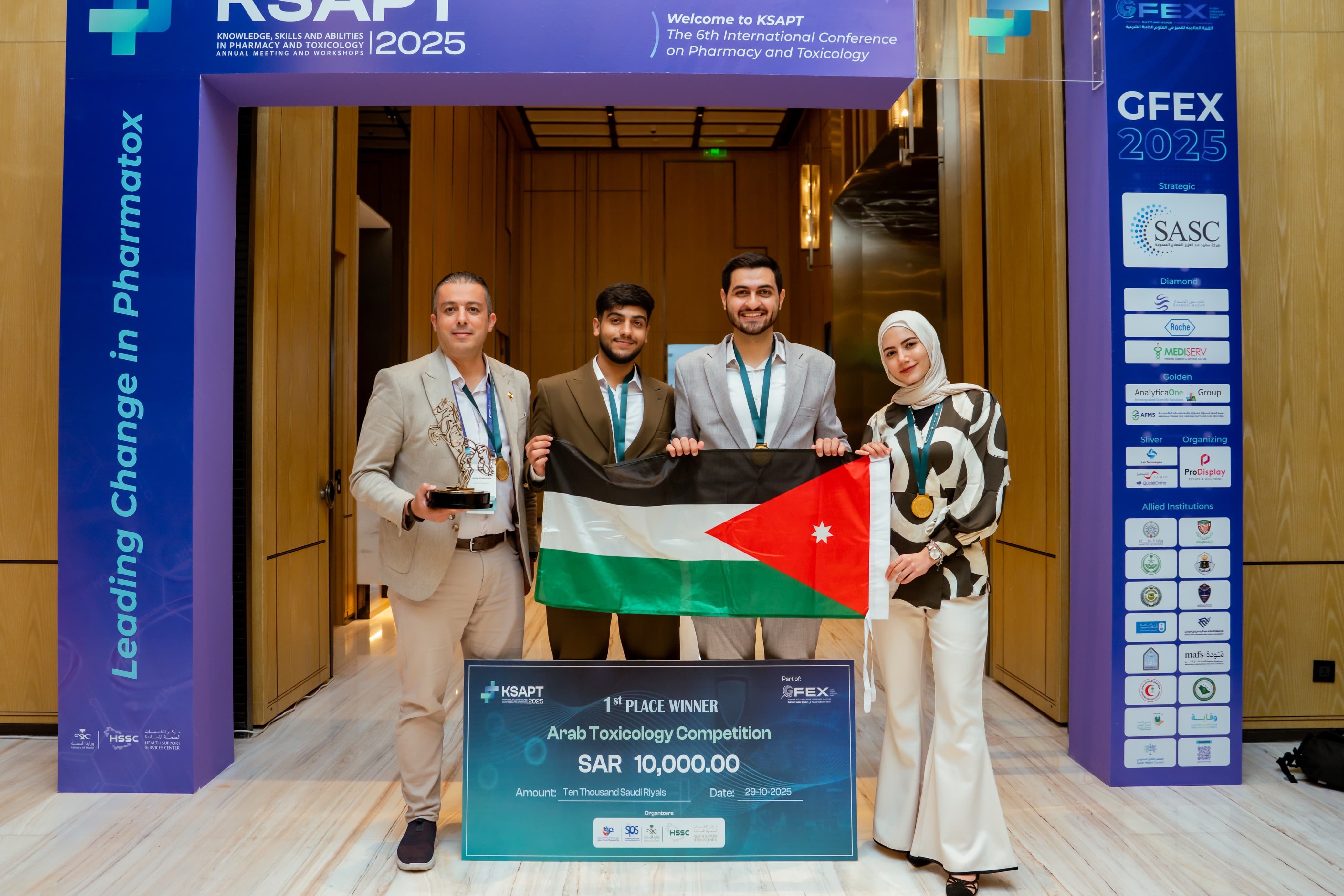

Radi was nominated to represent the University of Jordan’s Faculty of Pharmacy at the competition, which was held as part of the Global Forensics Excellence Summit in Saudi Arabia. The event brought together university participants from across the Middle East to test their knowledge, skills and abilities in pharmacy and toxicology.
The University of Jordan team ultimately finished first.
The result is notable not simply because of the ranking, but because toxicology sits at the intersection of several areas increasingly relevant to modern pharmaceutical work. Understanding how substances interact with the human body, identifying potential toxicity and interpreting scientific evidence all have applications across drug safety, pharmaceutical research and pharmacovigilance.
For Radi, the competition also came during a broader period of preparation for a career in the pharmaceutical industry.
She completed her Pharmacy degree at the University of Jordan in 2026 with a GPA of 3.93, ranking among the top 10 students in her class. Alongside her academic work, she pursued practical experience in community pharmacy and trained at Jordan University Hospital and Queen Alia Military Hospital. She later completed an internship at JPM, the Jordanian Pharmaceutical Company.
Taken together, those experiences give some context to the toxicology result. Radi’s university years were not confined to academic coursework. They included exposure to community practice, hospital pharmacy, pharmaceutical industry operations and scientific competition.
Her interest now centers particularly on pharmaceutical research and pharmacovigilance. The connection with toxicology is straightforward. Pharmacovigilance involves monitoring and evaluating the safety of medicines, including adverse drug reactions and other safety signals. Toxicological knowledge can therefore provide a useful scientific foundation for someone beginning work in drug safety.
Radi’s achievement also reflects a wider point about fresh pharmacy graduates entering Jordan’s pharmaceutical sector. With large numbers of graduates competing for early career opportunities, distinctions increasingly come from what candidates have done alongside their degrees. Research participation, internships, hospital exposure, competitions and demonstrated technical interests can help employers understand where a graduate’s abilities may translate into professional work.
Winning a regional competition does not substitute for industry experience, and the transition from university to a pharmaceutical company inevitably brings a new learning curve. It does, however, provide a concrete accomplishment at the beginning of Radi’s career.
As Nada Radi moves from the University of Jordan into the pharmaceutical workforce, her first place finish in Saudi Arabia provides an early marker of a career now turning from academic achievement toward practical work in pharmaceutical research and drug safety.